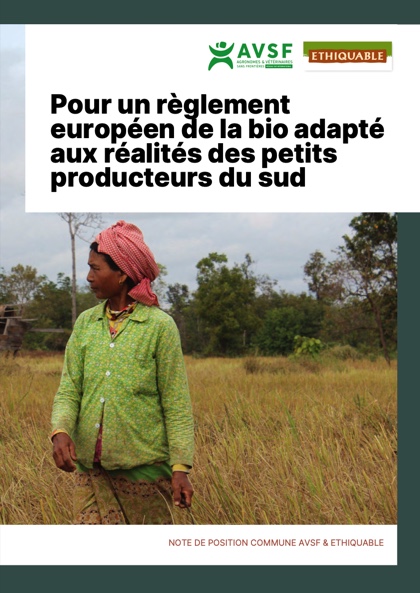
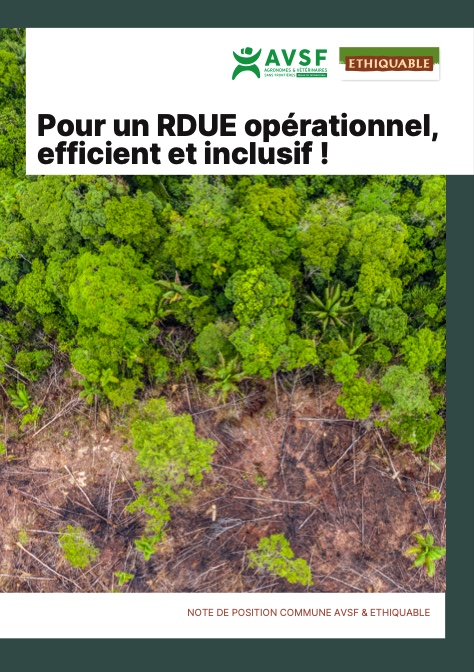
This text, published by Agronomes & Vétérinaires Sans Frontières (AVSF) and ETHIQUABLE, provides an update on developments in the European Regulation on deforestation (RDUE).
The European Regulation on Deforestation (EUDR) is set to come into force in January 2026 for large companies and in July 2026 for smaller ones—unless there is another postponement. Its aim is to ban imports of cocoa, coffee, soy, palm oil, beef, wood, and rubber from land deforested after 2020.
On paper, the objective is clear: to combat deforestation and make supply chains more transparent. This is a key concern at the heart of our approach. And there is a sense of urgency: in Côte d’Ivoire between 2000 and 2019, 2.4 million hectares of forest were replaced by cocoa plantations.
But on the ground, our cocoa and coffee producer partners are warning us that without appropriate support, this regulation risks excluding hundreds of thousands of small farmers from the European market.
The identified risks
⇢ Exclusion of the most vulnerable from the European market: the majority of producers will not have the means to prove the legality or traceability of their production when the regulation comes into force.
⇢ Data capture by large exporting companies, strengthening their power and control over producers.
⇢ Non-existent, vague, or inadequate government measures: complex, costly, and sometimes contradictory, they risk hindering the effective implementation of the regulation.
⇢ Unsustainable financial burdens: up to €107/ton of cocoa in Côte d’Ivoire for compliance, which is difficult for producers to absorb in full.
But also opportunities
⇢ Organic and fair trade cooperatives have a head start in complying with regulations, as they already have robust traceability tools in place.
⇢ The EUDR can encourage isolated producers to join or organize themselves into cooperatives.
⇢ The EUDR can become a lever for transparency and fairness in sectors where, today, only 6% of the value of cocoa goes to farmers.
Our common positions with ETHIQUABLE
In order for the EUDR to achieve its objective without sacrificing the most vulnerable producers, who will no longer have access to the European market, and while limiting the negative effects on producers organized into cooperatives, here are four essential conditions that we are calling for, together with the socially responsible cooperative ETHIQUABLE.
- Real technical and financial support, if not massive, for farmers’ organizations.
- Simplification of procedures for cooperatives that are already certified organic and fair trade.
- Ownership of producer data by producers.
- The establishment of guaranteed remunerative prices, an essential condition for the sustainable fight against deforestation.
Yes, ambitious regulations must be put in place to stop deforestation. But they must be operational, efficient, and inclusive.
At AVSF, alongside ETHIQUABLE and our producer partners, we advocate for an EUDR that is both a tool for protecting forests and a springboard for resilient and equitable smallholder agriculture.